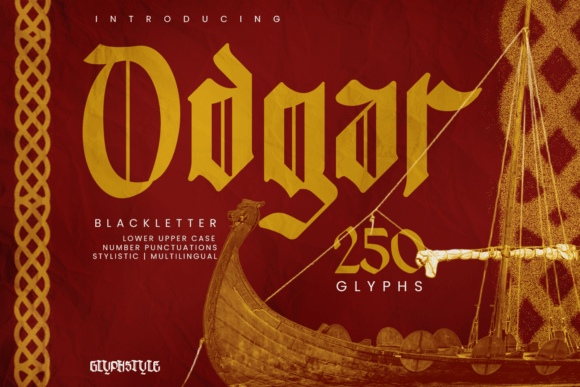
Odgar Blackletter: A Typeface Forged in Viking Legend
There’s a certain weight to history—a feeling you get when you hold an ancient tool or stand in a stone ruin. Some designs try to capture that feeling, and typography is one of the most direct ways to do it. Odgar Blackletter is a typeface that doesn’t just reference the past; it feels like it was pulled directly from a Norse saga. Inspired by Viking heritage and Norse mythology, this font carries the spirit of strength, honor, and ancient warfare in every letterform. Built with bold strokes, sharp angles, and classic medieval proportions, it delivers a powerful, heroic presence that’s hard to ignore.
If you’re working on a project that needs to convey legacy, power, or a touch of the epic, this is the kind of creative font that can anchor your entire visual identity. It’s more than just a decorative typeface; it’s a design asset with a distinct personality.
Where Does a Font Like Odgar Belong?
You might think a blackletter font is only for historical recreations or heavy metal logos, but its applications are surprisingly broad. The key is understanding its personality: it’s authoritative, textured, and deeply rooted in a specific aesthetic. This makes it a fantastic choice for projects where you want to make a strong, memorable statement.
Consider using Odgar for your brand identity if you run a craft brewery, a custom knife workshop, a historical tour company, or a fantasy-themed subscription box. The font instantly communicates a story of craftsmanship and tradition. For logo design, it creates an emblem that feels established and trustworthy—like a family crest or a guild mark.
Its impact isn’t limited to logos. Imagine this typeface on product packaging for artisanal goods, a poster for a historical film festival, or the title sequence for a video game set in a mythical past. In editorial design, chapter headings in a fantasy novel or a feature title in a history magazine would command attention. For digital creators, it’s perfect for striking social media graphics, YouTube thumbnails, or podcast artwork that needs to stand out in a crowded feed. Even for personal projects like wedding invitations with a medieval theme or custom merchandise for a band, the font adds a layer of depth and narrative.
Making It Work in Modern Design
Using a bold display font like Odgar effectively requires a bit of strategy. Its strength is also its challenge: it’s not meant for body text. Trying to read a paragraph set in a dense blackletter style would be exhausting. The goal is to use it as a headline or accent font to set a mood, then pair it with something highly readable for the supporting text.
This is where font pairing becomes your best friend. The contrast is what creates visual interest and ensures your message is clear. A classic approach is to pair a blackletter serif font with a clean, simple sans serif font. The sharp, medieval angles of Odgar would look excellent next to a neutral, geometric sans serif like Montserrat or Open Sans. This contrast allows the headline to be dramatic while the body copy remains accessible.
Another effective pairing is with a modest script or handwritten font. This can soften the overall feel just a touch, adding a human, crafted element alongside the historical weight. The key is to test your pairings. Create a simple mock-up with your headline in Odgar and your body text in a candidate font. Let it sit for a day and come back to it. Does it feel balanced? Is the hierarchy clear? Your goal is a professional presentation where every element has a purpose.
From Concept to Final Design: Practical Tips
Before you dive in, take a moment to review the included font styles. A premium font family often includes multiple weights or alternates. Odgar might come with regular, bold, or even distressed versions that mimic aged metal or wood. These variations can be incredibly useful. A slightly weathered version might be perfect for a vintage poster, while a cleaner cut could work better for a modern logo that needs a hint of historical flair.
Always consider the context of your project. For web design, ensure your chosen font files are optimized for fast loading. If you’re creating marketing assets like flyers or business cards, check the commercial licensing. Most reputable font licenses allow for a wide range of uses, from digital ads to printed merchandise, but it’s crucial to read the terms to avoid legal headaches down the line. This is part of building a sustainable and professional brand.
Think about the emotional resonance you want to create. The best typography doesn’t just look good; it feels right. Odgar Blackletter isn’t trying to be friendly or casual. It’s a typeface for stories about exploration, resilience, and legacy. Using it for a children’s party invitation would be a mismatch, but for a documentary about ancient explorers, it’s perfect. Match the typography to your project’s core goal, and you’ll create a visual language that resonates deeply with your audience.
In a world saturated with minimalist sans serifs and playful scripts, choosing a typeface with the gravitas of Odgar is a bold move. It’s a commitment to a specific aesthetic, one that promises depth and narrative. When used thoughtfully, it doesn’t just label your project—it defines its character, inviting your audience into a world you’ve built with intention. It’s a tool for designers, entrepreneurs, and creators who understand that the right visual voice can turn a simple idea into an unforgettable legend.